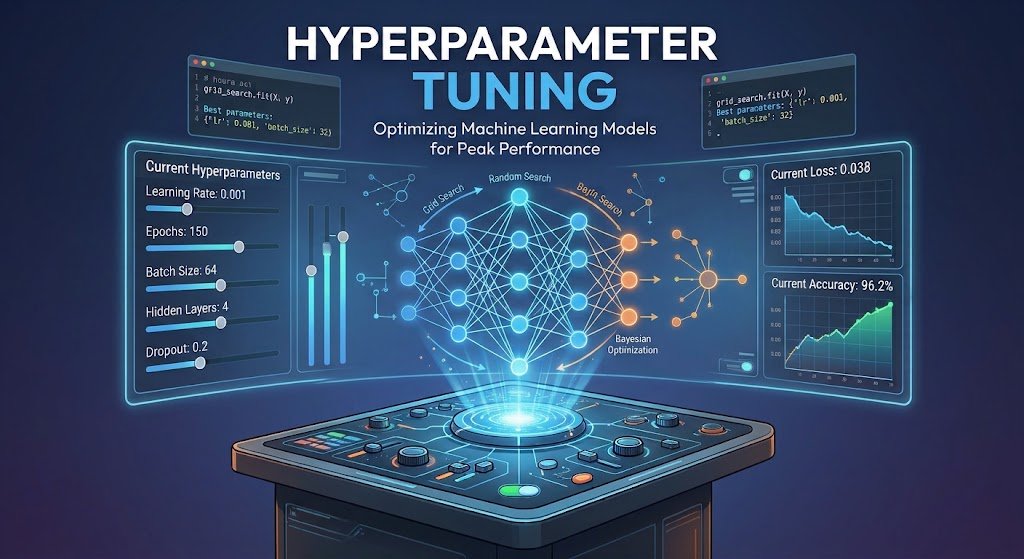
Machine learning models use algorithms to find patterns in data and make predictions. However, the way a model learns can be influenced by various settings that control its behavior. These are known as hyperparameters, choosing appropriate values for them has a significant impact on a model’s performance. Hyperparameter tuning is the process of adjusting these settings to find a combination that produces the most effective results.
Hyperparameters are set before or during the model’s training process configuration, rather than being directly learned from the training data. They determine aspects of how an algorithm operates, such as its complexity and ability to recognize patterns, making them different from model parameters, which are learned automatically as the model is trained. For example, a Linear Regression model learns coefficients from the data, whereas a Decision Tree can be configured with a maximum depth before training begins.
Hyperparameter tuning involves experimenting with different combinations of these settings and evaluating how they affect model performance. Say, a business developing a model to predict customer behavior might initially train a Decision Tree with a maximum depth of five. It could then test alternative depths, such as three, seven or ten, then compare the resulting performance. By assessing a variety of configurations, the business can identify which setting gives the most suitable balance between accuracy and generalization.
There are several approaches to hyperparameter tuning. Grid search involves testing every possible combination of values within a predefined selection. This can be useful when only a small number of settings are being considered, although it becomes computationally expensive when many combinations are involved. Random search takes another approach by selecting combinations randomly from specified ranges. Thus exploring a wider variety of settings without having to test every possible combination. More advanced approaches, like Bayesian optimization, use information from previous trials to guide the search towards potentially better combinations.
An important part of this technique is ensuring that the selected settings perform well on data that wasn’t used to train the model. Validation data is commonly used to compare different configurations, helping identify which settings are most effective beyond the training examples. Once tuning is complete, a separate test dataset is used to assess the final model. This ensures that the selected settings is also capable of performing well on data other than the data used during development.
Oracle Machine Learning supports hyperparameter tuning through its machine learning capabilities. In Oracle ML for Python, the AutoML ModelTuning functionality can automatically explore different hyperparameter combinations for supported classification and regression algorithms. Users may also define their own search ranges and choose an evaluation metric to guide the tuning process. Oracle’s Machine Learning for SQL provides configurable algorithm settings, allowing users to adjust model behavior, such as controlling the growth of Decision Trees. Such abilities help users improve model performance.
Lastly, hyperparameters and model tuning play a critical role in generating effective machine learning models. While algorithms provide the underlying learning approach, hyperparameters affect how that approach is applied to the data. Businesses can therefore determine the optimal settings that improve model performance and produce reliable predictions through these configurations.