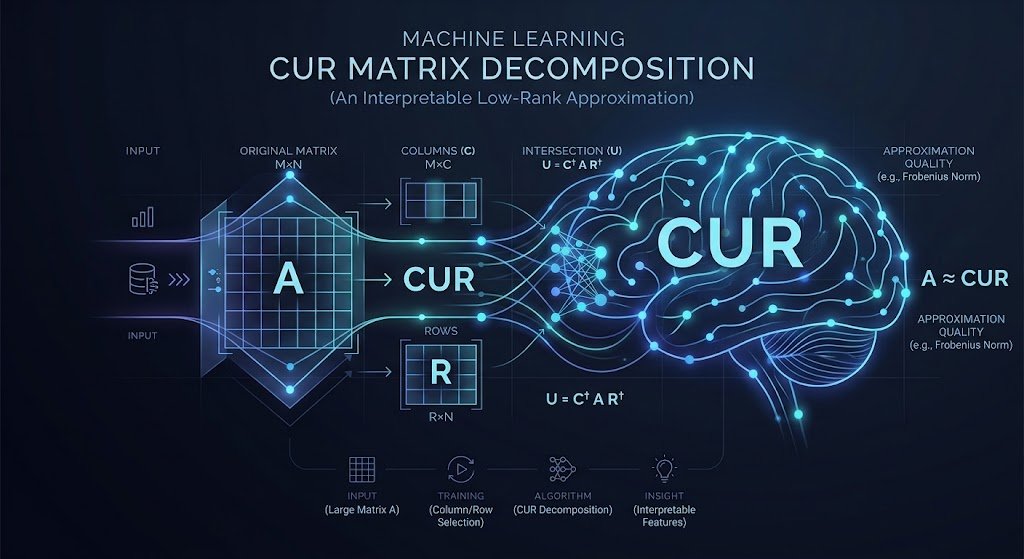
It’s often difficult to pinpoint the parts of the data which are most useful when analyzing datasets. A machine learning technique that simplifies this issue by identifying important rows and columns within a dataset is CUR Matrix Decomposition. Like in Oracle ML, it can be used to help organizations focus on the details that provides the greatest value.
The name CUR comes from the three components used to represent a dataset. The C represents selected columns, the R represents selected rows, and the U component connects these selections to provide an approximation of the original data. Instead of working with every part of a large dataset, the technique focuses on a smaller selection of its most informative elements.
One primary application of CUR Matrix Decomposition is finding important observations, which is closely related to Oracle’s Row Importance functionality. When a business has a very large dataset, not all records will contribute equally to understanding the data as a whole. CUR assists in identifying the particularly helpful observations allowing analysts to focus on a smaller number of records.
For example, a company could have millions of customer records containing information about consumption patterns. Rather than examining every customer individually, CUR Matrix Decomposition could help find a smaller selection of representative customers. These observations are then studied in more detail to gain a better understanding of the wider dataset.
Another aspect that CUR entails is its ability to help reduce the complexity of big datasets. Processing such vast amounts of information can require considerable computing resources, particularly when datasets contain many variables. By selecting a smaller number of meaningful rows and columns, CUR provides a manageable depiction of the original data while retaining important characteristics.
CUR Matrix Decomposition can also assist as part of a wider machine learning workflow. Reducing the amount of information that must be processed would make certain analytical tasks more efficient. Such a use case would therefore be valuable for organizations working with a range of data like customer, financial, scientific, or operational.
An interesting difference between this technique and Principal Component Analysis (PCA), is how they represent information. PCA creates new components by combining the original variables, whereas CUR selects actual rows and columns from the original dataset. This means that the information selected by CUR can be traced back to specific observations and variables, which can make the results easier to understand in certain situations.
However, reducing a dataset does come with considerations. Selecting a lower number of observations means that some information from the original dataset won’t be represented. For this reason, it’s important to ensure that the selected rows and columns still provide a useful representation of the data and are appropriate for the intended analysis.
In conclusion, CUR Matrix Decomposition provides an alternative way of breaking down datasets while maintaining a connection to the original information. By determining important rows and columns, it can help analysts focus on the most informative parts of their data and make broad scale evaluations more manageable. For businesses, this can support more efficient data interpretations as well as provide a clearer understanding of complex datasets.