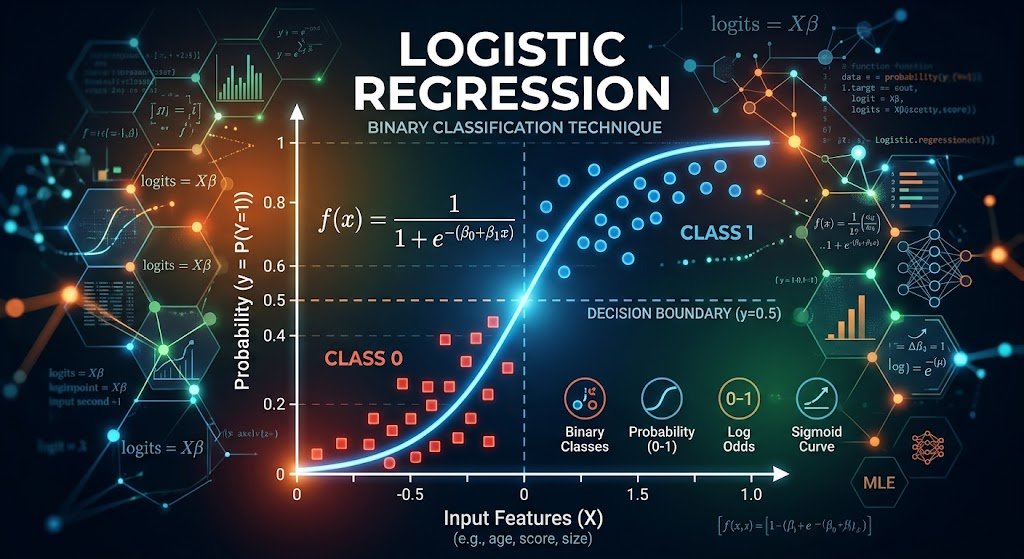





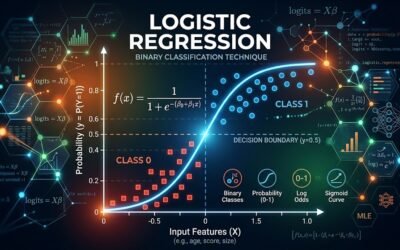
How Does Logistic Regression Work in Oracle ML
Logistic Regression is a supervised machine learning algorithm used to predict the probability of an outcome belonging to a particular category. Unlike ordinary regression, which is generally used to predict numerical values, Logistic Regression is designed for...
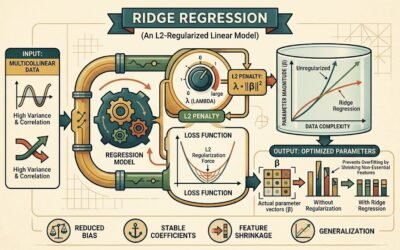
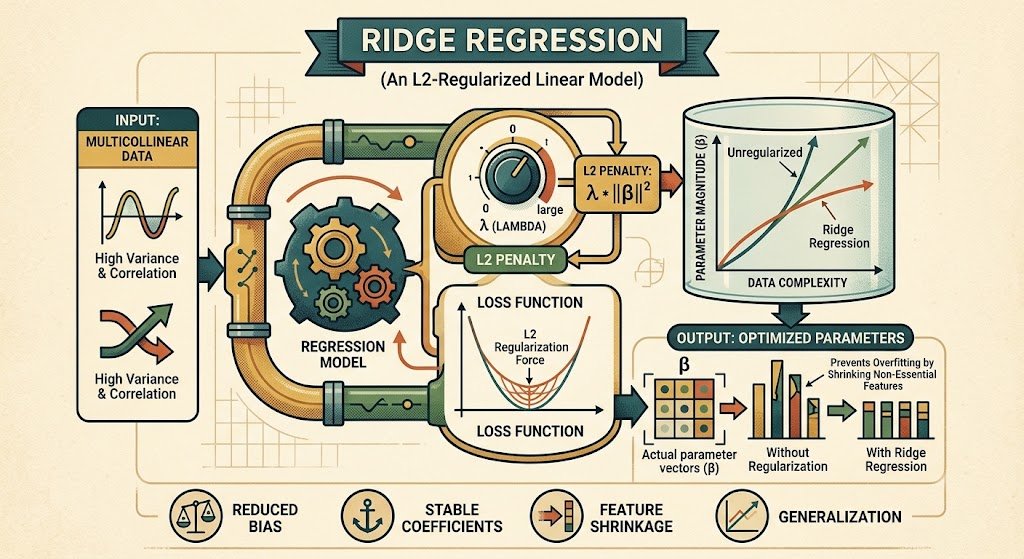
Use Cases of Ridge Regression in Oracle
Ridge Regression is a machine learning algorithm used to predict numerical outcomes while assisting with situations where input variables are strongly related to one another. This can be a problem in traditional regression due to the highly correlated variables that...
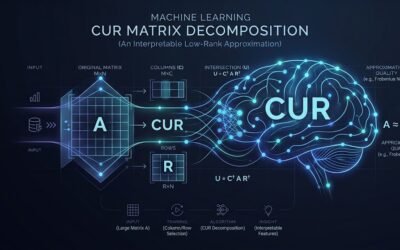
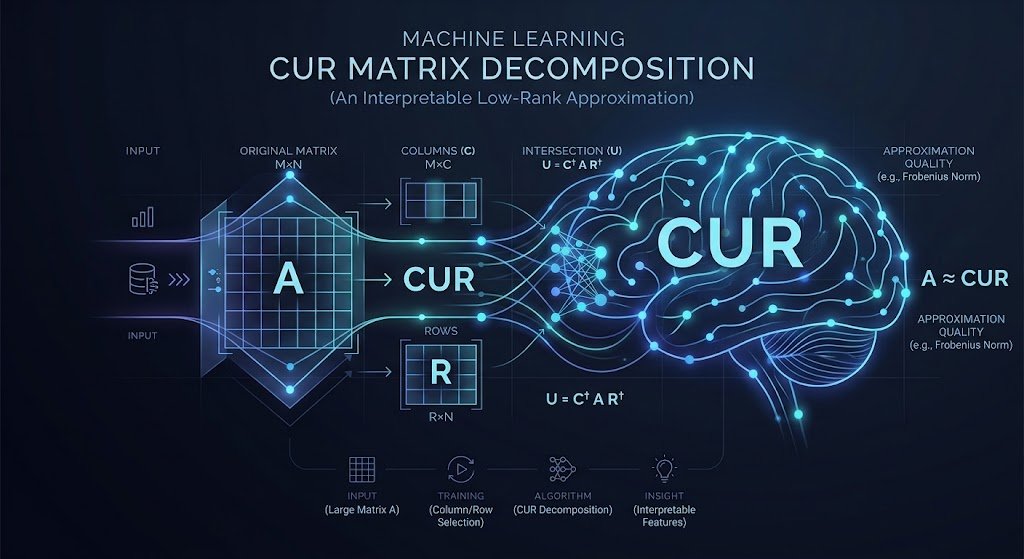
CUR Matrix Decomposition in Oracle Machine Learning
It's often difficult to pinpoint the parts of the data which are most useful when analyzing datasets. A machine learning technique that simplifies this issue by identifying important rows and columns within a dataset is CUR Matrix Decomposition. Like in Oracle ML, it...

How is Expectation Maximization Applied in Oracle
Oftentimes, it isn’t very obvious how the different records in datasets should be grouped. There may be patterns inside the data, but no predefined categories to tell us where each record belongs. Expectation Maximization or EM for short, is an unsupervised machine...
Responsible Artificial Intelligence in Oracle Enterprise Systems
Artificial Intelligence Must Be Built on Trust Artificial Intelligence is becoming an increasingly important part of modern enterprise technology. Organizations are using Artificial Intelligence to improve decision making, automate processes, analyze information and...
The Use Cases of One-Class SVM in Oracle
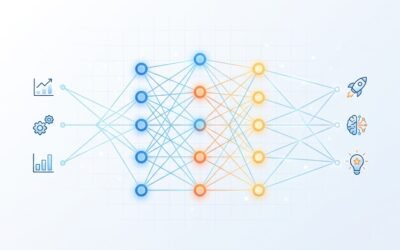
Not all machine learning problems are about predicting a known outcome. Sometimes the more interesting question is whether something looks unusual when compared with everything else. This is the idea behind One Class Support Vector Machine (One Class SVM). Supported...

Uses of Non-Negative Matrix Factorization in Oracle ML
Large datasets can contain a huge amount of information, this does not always make analysis easier. In many cases, the challenge is finding a simpler way to represent the data while keeping the patterns that actually matter. Non Negative Matrix Factorization (NMF) is...

How Does the Supported Oracle Algorithm O-Cluster Function
Finding significant data groups within datasets can be a challenge, especially when there are no predefined categories to work with. O Cluster, short for Orthogonal Partitioning Clustering, is an unsupervised machine learning algorithm developed by Oracle to...

Explicit Semantic Analysis in Oracle Machine Learning
Understanding text can be a difficult task for computers. While people can easily recognize the meaning behind words and phrases, computers need methods that assists them interpret language in a meaningful way. Explicit Semantic Analysis, also referred to as ESA, is a...

How is Singular Value Decomposition Implemented in Oracle Machine Learning
Singular value decomposition is an unsupervised machine learning technique used primarily for feature extraction and the transformation of high dimensional data into a lower dimensional space whilst keeping meaningful data properties (dimensionality reduction). When...

Best Practices for Oracle Incident Monitoring and Resolution
Even with proactive monitoring and regular health checks, there is still a risk of incidents happening within Oracle environments. Unpredictable hardware decline, workload growths or application issues can all affect the performance of a system. The difference between...

The Role of Root Cause Analysis in Long-Term Oracle Stability
Maintaining a reliable Oracle environment involves more than only responding to incidents as they occur. Although restoring services quickly is often the top priority, stability in the long run depends on understanding why the issue happened in the first place....

Oracle Performance Problems & How We Investigate them
Oracle environments are designed to support business-critical applications that organizations depend on every day. As systems grow and workloads increase, maintaining consistent performance becomes ever-more important. Even well-managed Oracle environments can...

How Early Detection Prevents Oracle Database Issues
Oracle databases play a central role in supporting business-critical applications and services. As organizations increasingly depend on these IT environments and infrastructures to manage daily tasks, maintaining their health and reliability can be taken through a...

Oracle Health Checks for Long-Term System Stability
Maintaining a stable Oracle environment asks more than simply responding to arising issues. In our experience, some of the most significant performance, security or availability challenges can often be avoided via regular health checks that identify potential risks...

How Proactive Monitoring is Essential for Modern Businesses
Oracle technologies are at the heart of today's many business-critical operations, supporting everything from the business sector in finance, human resources, supply chain management and to customer services. While implementing an Oracle solution is an important...

Principal Component Analysis
As datasets continue to grow in size and complexity, analyzing every variable can quickly become challenging. Many datasets contain hundreds or even thousands of features, some often provide similar information. Principal Component Analysis, also known as PCA, is an...

K-Means and its Functions
When working with large amounts of data, one of the hardest challenges is not knowing where to start. Data can contain thousands to millions of records, and without clear labels, it can be difficult to understand how those records relate to one another. K-Means...

How does Apriori Work and Benefit Businesses
When analyzing large datasets, some of the most valuable insights come from discovering relationships that might otherwise go unnoticed. This is where the Apriori algorithm comes in. Supported within Oracle Machine Learning, it is an unsupervised algorithm designed to...

The Use Cases of Generalized Linear Model in Oracle Machine Learning
When people think about machine learning, they often focus on advanced algorithms such as neural networks or random forests. However, some of the most useful predictive models are built upon well established statistical techniques. One example is the Generalized...

Oracle BYOM: Bringing Mathematical Intelligence into Enterprise Applications
The Next Evolution of Enterprise AI The conversation around artificial intelligence is often dominated by chatbots, virtual assistants, and large language models. While these technologies have captured headlines, they represent only one aspect of the AI revolution....
The Use Cases of Support Vector Machine in Oracle Machine Learning
Support Vector Machine (SVM) is a supervised machine learning algorithm that can be applied to both classification and regression problems. Its purpose is to detect patterns within data and make predictions by identifying the most effective boundary between different...

The Use Cases of Exponential Smoothing in Oracle Machine Learning
Exponential Smoothing is a forecasting algorithm used to analyze time based data and predict future values. It’s particularly useful when data is collected over regular intervals, such as daily sales figures, monthly revenue, or weekly demand. The algorithm works by...

The Use Cases of Naive Bayes in Oracle Machine Learning
Naive Bayes is a supervised machine learning algorithm consisting of three main types (Gaussian, Multinomial & Bernoulli). This probability-based algorithm is mainly used for classification tasks by using the relationships between different features to predict the...
The Use Cases of Random Forest in Oracle Machine Learning
Random Forest is a supervised machine learning algorithm used for both classification and regression tasks. It is based on the idea of combining multiple decision trees to produce a stronger and more reliable model. Instead of relying on a single tree, Random Forest...
The Use Cases of Minimum Description Length in Oracle Machine Learning
Minimum Description Length, often shortened to MDL, is a principle used in machine learning and data analysis to help identify models that best explain a dataset while avoiding unnecessary complexity. The main idea behind MDL is that the best model is one that...
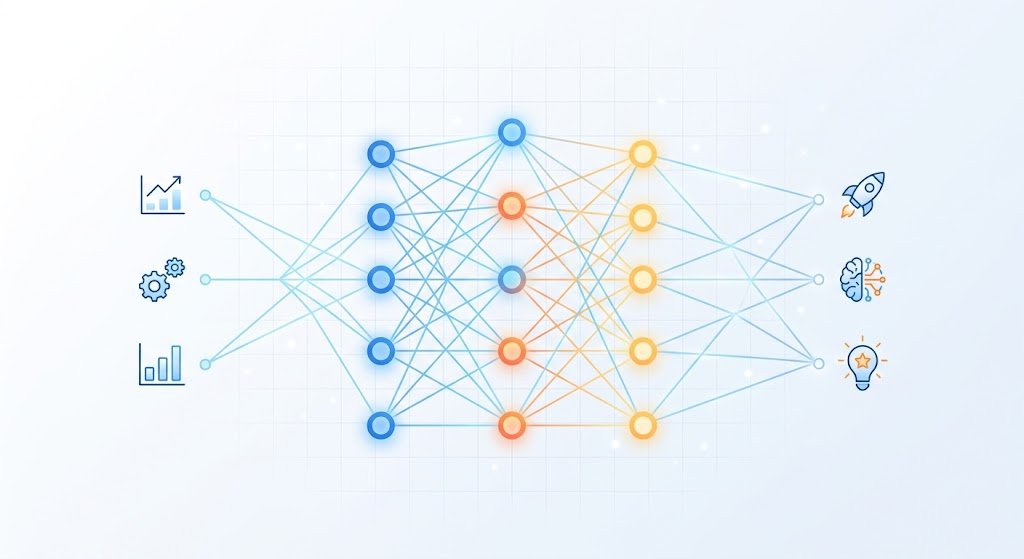
The Use Cases of Neural Networks in Oracle Machine Learning
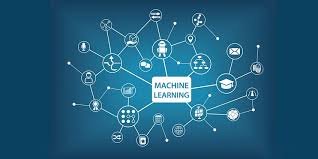
Neural networks are a machine learning technique inspired by the way the human brain processes information. They are designed to recognize patterns, learn from data, and make predictions by analyzing relationships between inputs and outputs. Neural networks are...

The Use Cases of Decision Tree in Oracle Machine Learning
Decision trees are a supervised machine learning technique used for both classification and regression tasks. They work by breaking down a problem into a series of simple decisions, creating a tree like structure of rules that lead to a final outcome. Each step in the...

The Use Cases of XGBoost in Oracle Machine Learning
XGBoost, short for Extreme Gradient Boosting, is a powerful machine learning algorithm used mainly for supervised learning tasks such as classification and regression. It is based on the idea of combining multiple simple models, typically decision trees, to create a...

The Use Cases of Ranking in Oracle Machine Learning
Ranking is a machine learning technique used to order items based on their relevance, importance, or likelihood of a particular outcome. Rather than simply predicting a value or assigning a category, ranking focuses on prioritizing results so that the most useful or...
CushySky
Ensuring Business Continuity And Minimizing Risks Through IT Operational Excellence
Contact
info@cushysky.com
Registered Office Address
Blockchain Tech Software LLC
30 N Gould St
Ste R
Sheridan
WY 82801
USA