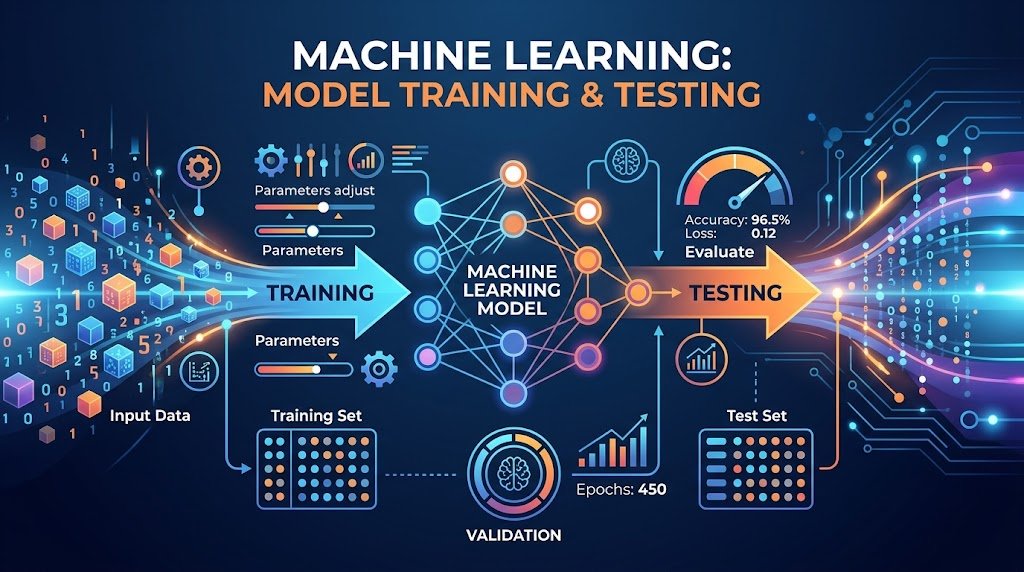
Machine learning models are designed to study patterns from data and use them to make predictions or identify relationships. However, before a model can be used in real world applications, it needs to be trained and tested. These two stages help determine whether a model has learned useful patterns and whether it can apply them to information it has not encountered before.
Model training is the process in which an algorithm learns from a dataset. The data contains examples that help the model identify correlations between different variables. For example, a retailer might train a model using historical sales information, including product prices and previous sales. By analyzing these, the model can learn patterns that can help it predict future sales.
The exact process depends on the algorithm being used. A Linear Regression model masters relationships between input variables and a numerical outcome, while a Decision Tree identifies rules that can be used to make predictions. Other approaches, such as Neural Networks, learn more complex patterns within data. Despite these differences, the aim of training is to develop a model that can perform its intended task effectively.
Once a model has been trained, it is important to evaluate how well it performs on separate data. This is where model testing becomes useful. Rather than assessing the model only on examples it has already seen, testing uses data that was held back during training. This provides a better indication of how the model might perform when given new information.
For example, a business developing a model to predict customer spending could use part of its historical customer data for training and reserve the remaining portion for testing. The model would learn from the training data before making predictions for the customers in the test dataset. These predictions could then be compared with the actual outcomes to assess how well the model performs.
The division between training and testing data is important because a model can sometimes learn the training examples too closely. This is known as overfitting, where the model performs well on its training data but struggles with new examples. Testing helps reveal this problem and provides a more realistic assessment of whether the model has learned patterns that generalize beyond the original dataset.
The amount of data allocated to each stage can vary depending on the size of the dataset and the problem being addressed. A common approach is to use around 80% of the data for training and 20% for testing, although other divisions can be appropriate. When enough data is available, a separate validation dataset could also be used to aid select model settings before the final evaluation.
Oracle Machine Learning for SQL supports model development & testing through its in database machine learning capabilities. Data can be divided into separate training and test datasets, allowing a model to be built using one set of examples and analyzed using another. The model can then be applied to test data to assess its ability to make predictions on unseen examples. Scoring is also supported, which involves applying a trained model to new data to generate predictions/other results.
To summarize, model training and testing are essential stages in developing useful machine learning systems. Training allows an algorithm to learn patterns from existing data, while testing determines whether those patterns remain useful when applied to new examples. By evaluating models beyond their training data, organizations can make better informed decisions about their performance and suitability for real world use.