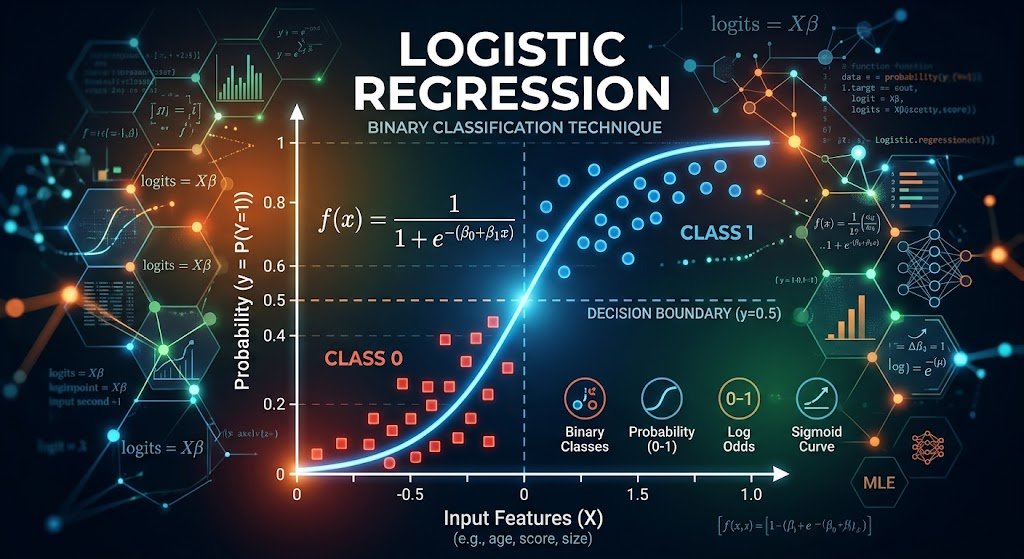
Logistic Regression is a supervised machine learning algorithm used to predict the probability of an outcome belonging to a particular category. Unlike ordinary regression, which is generally used to predict numerical values, Logistic Regression is designed for classification problems. It can be used when the answer is typically one of two answers such as yes or no, successful or unsuccessful, or whether an event is likely to happen.
Instead of simply producing a group, the algorithm estimates the probability of an outcome. For example, a bank could use it to estimate the likelihood that a customer will default on a loan. The model would consider factors such as income, previous payment history, existing debts etc. The resulting probability can then help classify the customer into a category.
A similar approach may be used in customer analysis (e.g. a company that wants to predict whether a customer is going to purchase a specific product). Previous purchases, website activity, responses to promotions and customer characteristics could all be used as input variables. Logistic Regression combines these factors to then estimate the chance of a purchase, helping businesses identify customers who may be more likely to respond to a particular offer.
The algorithm is also useful in healthcare and scientific research. For example, a model could estimate the probability that a patient has a particular condition based on factors such as age, test results and other measurements. Although this doesn’t replace professional diagnosis, it can help support medical personnel and identify patterns in data.
One helpful feature of Logistic Regression is that its results can be relatively easy to interpret compared with some more complex machine learning approaches. The model’s coefficients indicate how different input variables are associated with the predicted outcome. This can make it useful in situations where understanding the factors contributing to a prediction is important.
Logistic Regression can also be useful when working with many different variables. An example would be when an organization wants to utilize information about customer behavior, transactions and engagement to anticipate whether a customer is likely to leave a service. The model considers these different factors together rather than relying on a single measurement.
The probability produced by the model can also be converted into a classification by applying a threshold. Say if the predicted chance of an event is above a chosen threshold, the model could classify the case as positive. This makes Logistic Regression flexible because the threshold can be adjusted depending on the purpose.
Oracle Machine Learning supports Logistic Regression through its Generalized Linear Model capabilities. Oracle lists Logistic Regression as a classification method, allowing it to be used to build predictive classification models directly within the database.
To summarize, Logistic Regression provides a straightforward way to approach classification problems where understanding probabilities and relationships between variables is important. It can be applied to different areas such as finance, customer analysis, healthcare and risk assessment. While more advanced algorithms can sometimes produce more complex models, this algorithm remains a viable option when a combination of prediction, simplicity and interpretability is required.