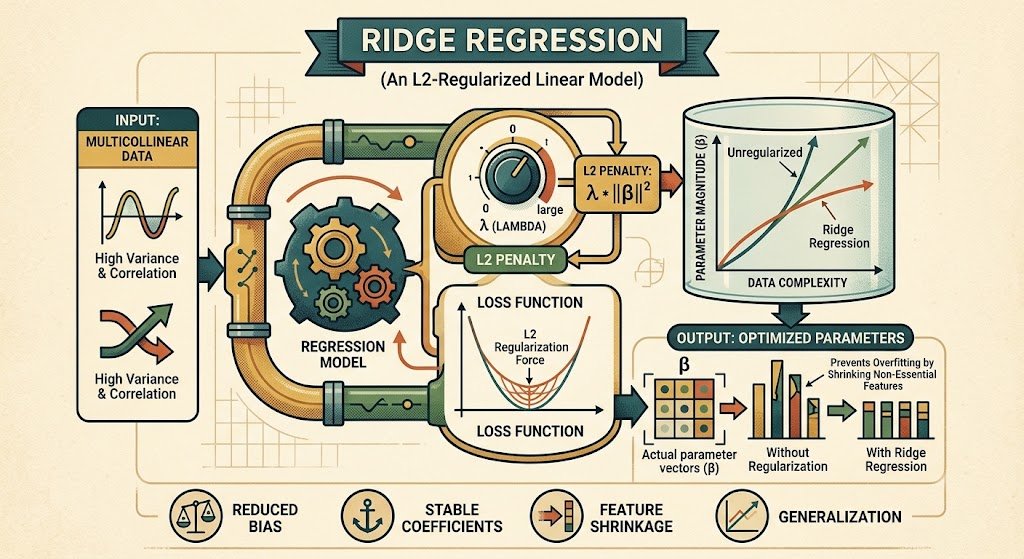
Ridge Regression is a machine learning algorithm used to predict numerical outcomes while assisting with situations where input variables are strongly related to one another. This can be a problem in traditional regression due to the highly correlated variables that make a model less stable and less able to determine the individual effect of each variable. Ridge Regression addresses this issue by adding a form of regularization to the model, helping to prevent the coefficients from becoming too large.
The basic idea behind the algorithm is similar to standard linear regression. The model looks at the relationships between input variables and a numerical target, such as predicting house prices from property characteristics or estimating future sales from business data. The difference is that Ridge Regression places a penalty on large coefficients. This encourages the model to keep its coefficients smaller, which can make the resulting model more steady when several predictors contain similar information.
This is particularly valuable when a dataset contains multicollinearity. Multicollinearity occurs when two or more input variables are highly correlated with each other. For example, a model predicting house prices might include both the size of a property and the number of rooms. These variables may provide overlapping information, making it difficult for a traditional regression model to distinguish their individual contributions. Ridge Regression helps compensate for this issue and produce a more reliable model.
Ridge Regression can be useful in financial analysis where a lot of economic indicators may be connected to one another. A model predicting financial outcomes often contains interest rates, employment figures and consumer spending, which can sometimes move together. Rather than allowing these relationships to make the model unstable, Ridge Regression reduces the influence of individual coefficients and produces a controlled prediction.
It can also be applied to customer and business data. A company may want to predict how much a customer is likely to spend based on factors like purchase history, visit frequency and promotion engagement. Some of these variables may be closely connected. Thus the algorithm would ensure these factors remain part of the model while minimizing any problems caused by their overlap.
Another useful application is when a dataset contains a large number of related variables. Removing some simply because they are correlated is not always desirable, as each one may still contain practical information. Ridge Regression provides an alternative by retaining these variables while controlling their influence on the model. This specifically helps when the main goal is accurate prediction instead of producing the simplest possible model.
Oracle Machine Learning supports Ridge Regression as a regression algorithm and can utilize it within its in database machine learning capabilities. Oracle documentation also explains that Ridge Regression can be used to compensate for multicollinearity.
One of the main advantages of Ridge Regression is therefore its ability to make regression models more stable regardless of when predictors are closely related. It doesn’t necessarily remove these variables from the model, but lessens the impact of their coefficients and so allows more of the available information in a dataset to be retained.
Lastly, Ridge Regression is a useful extension of traditional regression for data where input variables overlap strongly. By introducing regularization, it can produce better predictions and provide a method to handling multicollinearity. Within Oracle Machine Learning, it adds another option for building regression models where a standard approach may struggle.