When building a machine learning model, it’s important for the model to learn useful patterns from the data without becoming too simple or closely focused on the examples it has already seen. Two common problems that can occur are known as overfitting and underfitting. Understanding these issues will help produce a better model, just because it performs well on its training data doesn’t necessarily mean it’ll perform well when given new data.
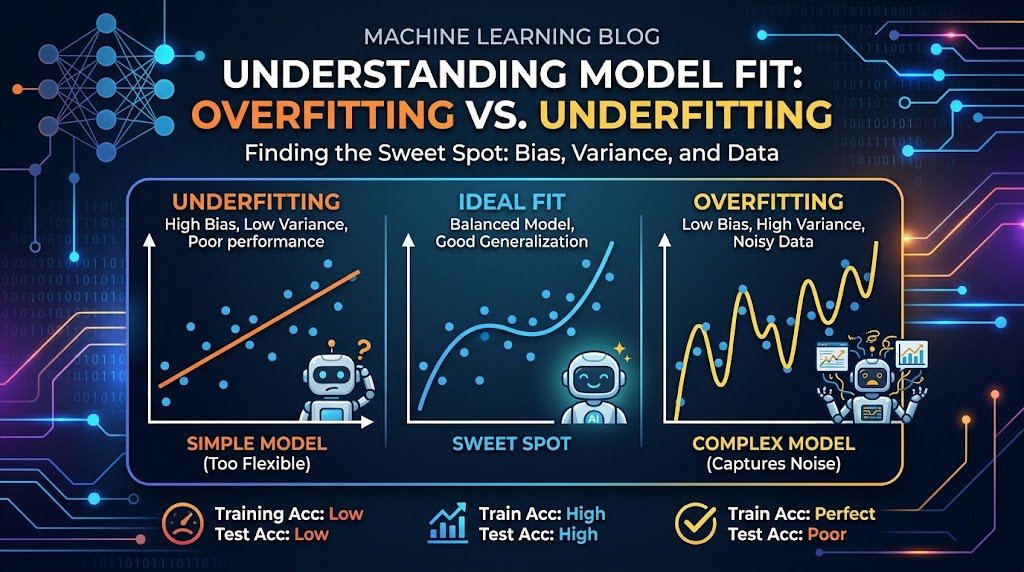
Overfitting happens when a model learns the training data too closely. Instead of studying the general patterns that are useful for making predictions, it sometimes also learns random variations or noise within the dataset. As a result, the model could perform extremely well on the data used to train it but perform considerably worse when it encounters new information.
For example, imagine a company building a model to predict customer spending. If the model becomes too fitted to the particular customers in its training dataset, it might recognize very specific patterns that do not apply to the general audience. Although its predictions on the original dataset would be impressive, its performance could fall when new customers are introduced.
Underfitting occurs in the opposite situation. A model is too simple to properly capture the important relationships within the data. It may therefore perform poorly on both the training data and new data. One instance is if customer spending is influenced by several different factors, however the model only considers one simple relationship. This would mean it’ll fail to capture much of the useful information available.
The goal is to therefore find an appropriate level of complexity. The model needs to be complex enough to identify meaningful patterns, but not so much so that it starts learning unwanted details that are specific to the training data. This is often described as finding a balance between learning too little and learning too much.
One way to identify these problems is to compare a model’s performance on training data with its performance on separate test data. A model that does very well during training but much worse during testing may be showing signs of overfitting. If it performs poorly on both, it’s likely underfitting.
Oracle Machine Learning provides tools for developing and evaluating machine learning models, allowing users to work with various data as part of the modeling process. Within Oracle Machine Learning for SQL, data can be divided into training and test sets so that a model can be assessed using data that wasn’t used during training. This can assist in identify whether a model is generalizing well or showing signs of overfitting.
There are also numerous ways to reduce overfitting. One approach is regularization, which places restrictions on a model so that it doesn’t become unnecessarily complex. Ridge Regression is an example of this idea. Other approaches include limiting the complexity of certain models, using appropriate training and testing methods, and selecting useful input variables.
Underfitting can sometimes be addressed by allowing the model to capture more complex relationships. This could involve using additional relevant variables, choosing a more suitable algorithm or adjusting the model’s settings. However, simply making a model more complicated is not always the solution, as excessive complexity can eventually lead to overfitting.
Overfitting and underfitting often occur across many different machine learning types. Therefore, they aren’t necessarily specific to classification or regression. Decision Trees, Neural Networks, Support Vector Machines and other algorithms can all be affected depending on how they are configured and the data being used.
Overall, overfitting and underfitting describe two opposite issues in machine learning. Underfitting happens when a model is simplified to the point where it can’t capture important patterns, while overfitting occurs when it accesses the training data too closely. Finding the right balance allows it to learn helpful relationships while remaining capable of making reliable predictions on new data. This is a vital part of developing ML models that can be useful beyond the original dataset.