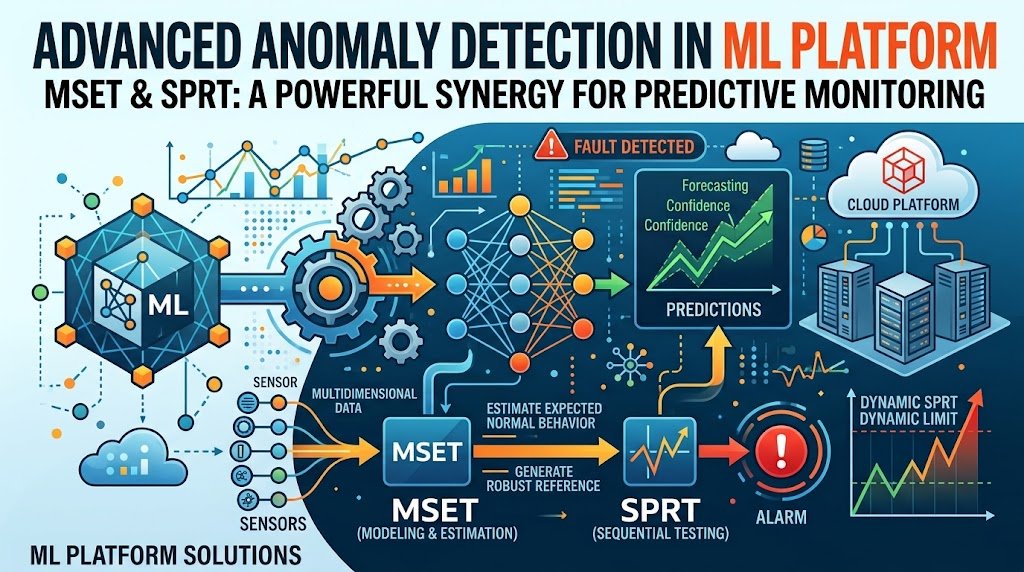
MSET SPRT is a machine learning approach designed to detect subtle anomalies in systems that are monitored over time. Its full name stands for Multivariate State Estimation Technique and Sequential Probability Ratio Test. Instead of simply looking for unusual individual values, it examines multiple signals together and looks for changes that could indicate that a system is beginning to behave differently from its normal state.
Because of this, MSET SPRT becomes helpful at monitoring equipment, sensors and other systems that continuously produce measurements. For example, an industrial machine may generate readings for temperature/pressure/vibration/electrical current. Each variable could appear reasonable on its own, but changes across several measurements at the same time would indicate a possibility that the machine is developing a problem. The technique is able to use historical data representing normal operations to establish what the expected behavior of the system looks like.
The MSET part of the approach approximates how the monitored signals should behave based on their relationships with one another. When new data arrives, the estimated values can be compared with the actual measurements. The differences between them, known as residuals, can then provide an indication that something has changed. The SPRT component helps find out whether these changes are significant enough to be treated as an anomaly rather than normal variation.
A major application is predictive maintenance. Manufacturing equipment can be monitored constantly for changes that may suggest a component is starting to fail. Detecting these changes early allows maintenance to be scheduled before a more serious failure occurs. This can be particularly valuable for equipment where unexpected downtime could interrupt production or create significant holdups.
The approach can also be applied to large computing or network environments. Naturally, servers, storage systems and networks produce many measurements over time, making it hard to manually identify unusual behavior. MSET SPRT can monitor and look for changes that point to a developing issue. Oracle also highlights the use of anomaly detection for business critical enterprise computing systems and networks.
Another useful feature is that MSET SPRT can work with multiple sensors simultaneously. This is important since an anomaly isn’t always obvious from a single measurement. A gradual change across several related signals would provide stronger evidence that a system is moving away from its optimal operating condition.
The quality of the data is particularly important. MSET SPRT learns what normal behavior looks like from historical operating data, so the training data needs to represent the different normal conditions that the system can experience. If an important operating state is missing, the model may produce false alerts when that state occurs later. Oracle notes that the model is stationary, meaning it does not automatically evolve as it monitors new data.
MSET SPRT is designed for long term, time ordered sensor data and works with numerical measurements. This makes it different from the general anomaly detection approaches that can be applied to ordinary datasets. Its specifically suited to situations where the order and progression of observations matter, such as monitoring a machine as its condition changes over time.
Oracle Machine Learning for SQL supports MSET SPRT as an anomaly detection algorithm. Predictions can identify whether observations are considered normal or an outlier, and Oracle can provide details about the signs contributing to an anomaly. For very large numbers of sensors, Oracle can also use random projections to improve scalability, although this changes the type of prediction details available.
To sum it up, MSET SPRT provides a specialized strategy to anomaly detection for systems that generate continuous streams of sensor data. By learning normal behavior and monitoring how new observations vary from expectations, it can help organizations identify subtle changes before they develop into larger problems.