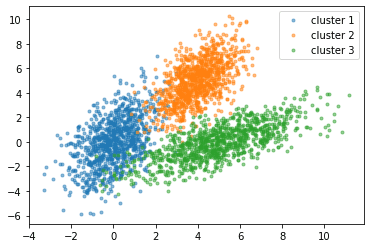
Previously the supported algorithms of the three main supervised machine learning techniques were covered. In this post, the supported algorithms of the unsupervised ML techniques will be covered. By definition, these algorithms analyze data without predefined labels or targets. They identify relationships and patterns rather than learning from known solutions. These unsupervised ML algorithms will use the four main unsupervised techniques; Clustering, Association rules, Anomaly detection and Feature extraction.
K-Means = These divide the dataset into a predetermined number of clusters by minimizing the distance of points to cluster centroids.
Expectation Maximization (EM) = A probability clustering technique that assigns cluster membership based on probability and estimates the data’s underlying distribution.
Orthogonal Partitioning Clustering (O-Cluster) = A grid-based, hierarchical clustering method that identifies dense regions in attribute space and forms clusters based on density thresholds.
Apriori = A classic association algorithm for market-basket analysis, finding frequent item sets and derives rules that meet minimum confidence thresholds and support. These rules express likely co-occurrence patterns in the data.
Multivariate State Estimation Technique-Sequential Probability Ratio Test (MSET-SPRT) = A non parametric technique that models normal multivariate behavior and detects subtle deviations with low false alarms, commonly used in critical system monitoring.
One-Class Support Vector Machine (SVM) = Trains a model on normal data only as well as flags cases falling outside that learned profile as anomalies.
Explicit Semantic Analysis (ESA) = Uses a known knowledge base to represent concepts as features often applied in documents or semantic contexts.
Non-Negative Matrix Factorization (NMF) = Factorizes the data into non-negative components, producing new features that are combinations of the originals.
Singular Value Decomposition (SVD) = A linear transformation that decomposes data into orthogonal components ranked by importance.
Principle Component Analysis (PCA) = A specific application of SVD that finds directions of maximum variance for dimensionality reduction.
In conclusion, the supported unsupervised OML algorithms provide flexible methods for finding patterns and structure in unlabeled data. These techniques can help transform businesses by supporting data-driven decision making. Clustering can improve customer segmentation and personalization, association rules can optimize product placement and recommendations, anomaly detection can help identify fraud and operational risks whilst feature extraction can enhance downstream analytics and predictive models.
